The Angelo Fencing Dynasty
Angelo Domenico Malevolti Tremamondo (Domenico Angelo) was born in Livorno Italy in 1716
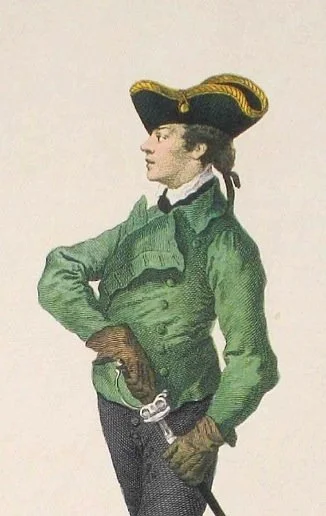
Domenico Angelo
Domenico Angelo received his initial training in the Italian method of fencing in Pisa.
In Livorno and Tuskany he got into a few too many encounters and deemed it prudent to move to avoid the revenge of relatives. He moved to Paris at the age of 27, with an eye to taking over the family business, but found himself gaining fencing skills training with Bertrand Teillagorry in the classical french foil at the Royal Association of Masters. In 1750 he would meet English actress Peg Woffington and accompany her back to London where he would eventually marry (Feb 5th 1755) Elizabeth Johnson with whom he had several children
Domenico established a fencing school, Angelo's School of Arms in Carlisle House, in Soho, London. In 1755. Many famous personalities trained with Angelo. He would gain the patronage of the 10th Earl of Pembroke. In 1758. He would become fencing master of the British royal family after he gained the patronage of the dowager Princess of Wales, who appointed him as riding and fencing master to George, Prince of Wales, and his brother Edward, duke of York. He would also establish himself as fencing master at Eton College.
With the help of artist Gwyn Delin, he wrote and published , L'École des armes'' (English: The School of Fencing), published in England in 1763 It can be purchased in a later publication here. #commissionearned also available here
In 1764 he bought Carlisle House at Soho Square, where he taught the aristocracy. He was now able not only to entertain on a large scale but also to widen his professional scope. He began to take pupils as boarders (at a fee of 100 guineas a year) and, soon after moving into the house, built a riding school on what had been the back garden. His students would eventually include the future King William IV (King of the United Kingdom of Great Britain and Ireland and King of Hanover) During the next decade Carlisle House became the most fashionable school of arms and manners in London. Angelo made a large income and lived very comfortably.
Domenico Angelo retired in 1780 turning his school over to his son. He seems to have left Carlisle House in the 1780s and would die 1802 in Twickenham, England.
Henry Charles William Malevolti (Henry Charles William Angelo) was born April 1756 at St James's Place, Piccadilly, London.
Henry Angelo Sr. grew up among four sisters and one brother, as the eldest child of the family. He attended first William Rose's school in Chiswick and then, in 1764, Eton College (where his father taught fencing). In 1772, he began his formal training as a fencer, practicing swordsmanship under Monsieur Motet in Paris. Around 1775, he had returned to England to become his father's assistant.
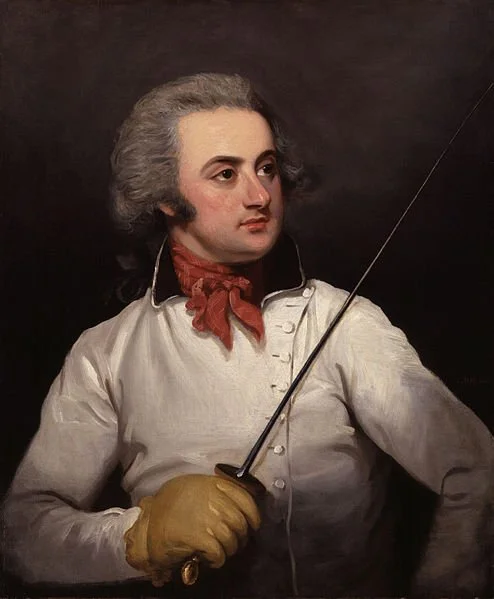
Henry Charles William Angelo b 1756 - d 1835
Henry Angelo would marry in 1778 and have his first child in 1799, with the Duke of York agreeing to be the godfather. Angelo had four sons in total, the second of whom, Henry Charles Angelo Jr. born in 1780.
Henry took over Domenico’s school at the prestigious Eton College and would take over the fencing dynasty his father had started, assuming control of his fathers fencing school in 1780, Shortly after Angelo moved the school's premises to Her Majesty's Theatre, Haymarket. He would go on to develop a system of military swordsmanship – Hungarian and Highland Broad Sword (1798), and The Guards of the Highland BroadSword (1799). Henry Angelo’s system would be taught to the London and Westminster Light Horse Volunteers which included light infantry support units.
In 1787, Henry Angelo reissued his father's L'école des armes of 1763 under the title “The School of Fencing”.
June 17th, 1789, Her Majesty's Theatre was burned down and Angelo was forced to move to new premises at 13 Bond Street, which he occupied alongside the boxer John Jackson. Angelo did not settle during his final years of teaching, tutoring at around forty schools in total, before an injury by actor Edmund Kean in 1817 forced him into retirement. The management of the school was then passed to his son, Henry Charles Angelo.
In retirement he continued to publish works on fencing. In 1817, he reissued his father's School of Fencing, under the title A Treatise on the Utility and Advantages of Fencing, with a biography of his friend, the composer, violinist and fencer, Joseph Bologne, Chevalier de Saint-Georges. He would publish two memoires.
Henry Angelo died at Twickenham in 1835.
Henry Charles Angelo the Younger was born in London in 1780.
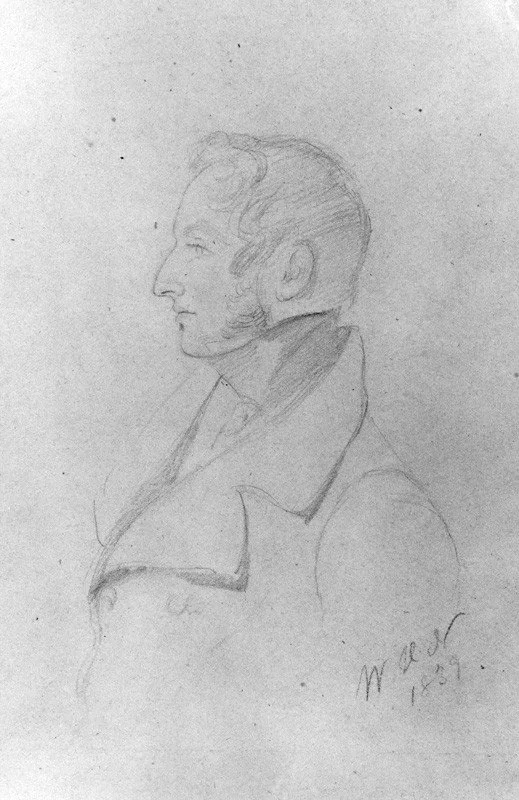
HEnry Charles Angelo the Younger
Henry Angelo began teaching the use of the saber to the military even before taking over his father’s fencing school. Around the year 1813, he began to teach the Royal Navy a form of cutlass exercise.
By 1815, and perhaps sooner, Henry Charles Angelo was teaching an infantry sword exercise to troops serving in France. And, finally in 1817, his system was officially accepted as the new standard for the British army. This would be the first infantry sword exercise officially adopted by the British Military. “The Infantry Sword Exercise” would be reprinted several times and would remain the standard until near the end of the 19th century.
Infantry Sword Exercise (1845) can be purchased in reprint here #commissionearned
The younger Henry took over his father's fencing academy in Bond Street from his father in 1817. He subsequently moved it to St. James's Street (1830-1896). He was superintendent of sword exercise to the British Army and the Royal Navy (1833-1852).
Henry Angelo the Younger, died in 1852. He is buried in Kensal Green Cemetery.