Chevalier de Saint-Georges
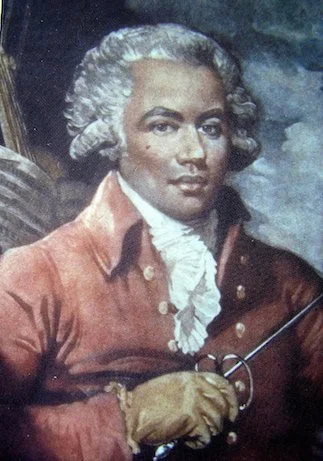
Joseph Bologne, Chevalier de Saint-Georges
Joseph Bologne, Chevalier de Saint-George was born December 25th 1745 in the French colony of Guadeloupe in the Carribean. His father, Georges Bologne de Saint-Georges, was a wealthy, white plantation owner, while his mother was one of the Senegalese enslaved people named Nanon that Georges kept enslaved.
Although he had a number of white siblings, Georges took a special liking to Joseph, and in 1753 took his son, age seven, to France, and installed in a Jesuit boarding school in Angoulême so his uncle Pierre could keep an eye on him. There he began his education in a variety of arts including fencing and music.
At the age of 13, Joseph was enrolled in a private fencing academy run by Texier de La Boëssière in Rue Saint-Honoré across from the Oratoire du Louvre, practising horse riding in the Salle du Manège. According to the son of the fencing master La Boëssière, “At 15 his progress was so rapid, that he was already beating the best swordsmen, and at 17 he developed the greatest speed imaginable.”
He was still a teenaged student when he publicly defeated the adult Alexandre Picard, a renowned fencing-master in Rouen who had foolishly referred to Saint-Georges as “Boëssière’s mulatto.” The 1761match was attended, and bet upon, heavily by the public. The incident was a major affair for Bologne and his father would reward Joseph with a horse and buggy.
In 1764, when violinist Antonio Lolli arrived in Paris, the Italian composed two concertos, Op. 2, for the chevalier. Lolli's dedication was to Joseph's father: "To M. de Bologne de Saint-Georges, who gave the arts a priceless gift in the person of his son.” In 1766, François-Joseph Gossec dedicated a set of six string trios, Op. 9, to Saint-Georges.
After finishing school in 1766 he would be appointed as a "gendarme de la garde du roi" by king Louis XVI in Versailles and a chevalier. He then adopted the suffix of his father's plantation and was known as the "Chevalier de Saint-Georges".
In 1769, the Parisian public was amazed to see Saint-Georges, well known for his fencing prowess, playing as a violinist in Gossec's new orchestra, Le Concert des Amateurs in the Hôtel de Soubise.
Saint-Georges's first composition Op. 1, probably composed in 1770, was a set of six string quartets, among the first in France, published by famed French publisher, composer, and teacher Antoine Bailleux. Also in 1770, Carl Stamitz dedicated his own set of six string quartets to Saint-Georges. By 1771, Gossec had appointed Saint-Georges as the concert master of the Concert des Amateurs. In 1772, Saint-Georges debuted as a soloist with the Concert des Amateurs. He played his first two violin concertos, Op. II, with Gossec conducting the orchestra. The concertos garnered a highly positive reception, and Saint-Georges, in particular, was said to be "appreciated not as much for his compositions as for his performances, enrapturing especially the feminine members of his audience". In 1773 Saint-Georges would be designated as the new conductor of the Concert des Amateurs.
He continued to fence daily in the fencing venues of Paris. There he met the fencing masters Domenico Angelo and his son Henry, the Chevalier d'Éon, and the teenage Louis Philippe II, Duke of Orléans, all of whom would play a role in his future. Henry Angelo often went to fence with Saint-Georges while in Paris, and wrote about him in his memoirs:
“No man ever united so much suppleness with so much strength. He excelled in all the bodily exercises in which he engaged…He was a skillful horseman and remarkable shot; he rarely missed his aim when his pistol was once before the mark…but the art in which he surpassed all his contemporaries and predecessors was fencing. No professor or amateur ever showed so much accuracy and quickness. His attacks were a perpetual series of hits; his parry was so close that it was in vain to attempt to touch him; in short, he was all nerve.”
Angelo would also say
“It may not be unworthy of remark that from his being much taller, and, consequently, possessing a greater length of lunge, I found that I could not depend upon my attacks unless I closed with him. The consequence was, upon my adopting that measure, the hit I gave him was so ‘palpable’ that it threw open his waistcoat, which so enraged him that, in his fury, I received a blow from the pommel of his foil on my chin, the mark of which I still retain. It may be remarked of that celebrated man that, although he might be considered as a lion with a foil in his hand, the contest over he was as docile as a lamb, for soon after the above engagement, when seated to rest himself, he said to me: ‘Mon cher ami, donnez-moi votre main; nous tirons tous les jours ensemble.’”
For a time, the Chevalier acted as Marie Antoinette’s personal music tutor—until he got fired for getting “too close” to his royal charge. Even then Marie went to his symphonies, played piano with him at intimate gatherings, and in 1776, she publicly supported the Chevalier’s dream of becoming the Paris Opera’s new director. However, this prospect was thwarted by opposition from certain performers who resisted the idea of being led by an individual of colour. Three of the Opéra's leading ladies (Marie-Madeleine Guimard, Rosalie Levasseur, and Sophie Arnould) petitioned the Queen in opposition to his appointment, saying "that their honor and delicate conscience could never allow them to submit to the orders of a mulatto".
Captain Alfred Hutton relates the story of Saint Georges and the Captain of Hussars in his book “The Sword and The Centuries” - sadly he doesn’t provide a date.
Our great fencer happens to be staying at Dunkirk, where a man of such varied accomplishments is naturally much sought after. He finds himself one day among a party of ladies and gentlemen, when a young Captain of hussars makes his appearance. He has a most overweening sense of his own importance, especially in matters concerning the sword, and has the hardihood to boast that not a fencer in the whole of France can touch him at all. "That is interesting," says one of the ladies, "but did you ever happen to meet with the celebrated Saint Georges?" Quoth the Captain:"Saint Georges? Oh yes; I have fenced with him many a time. But he is no good; I can touch him just when I please." The ladies all look at one another. Saint Georges remarks quietly: "Dear me, how very odd! I should rather like to cross blades with you myself, and if a pair of foils were forthcoming a few thrusts might amuse the ladies." To this suggestion the hussar accords a supercilious assent. As luck will have it, the needful weapons are in the house,and they are at once produced. The Captain, seeing that he is opposed to a man much older than himself, is inclined to treat him with contempt, when the veteran fencer calmly turns to the ladies and asks them to name the particular buttons on the gentleman's coat which they would like him to touch. .They select half a dozen or so. The pair engage. The famous swordsman plays with his man for a few minutes for the benefit of his audience, and then proceeds to hit each of the named buttons in rapid succession, and finishes by sending the foil of his vainglorious enemy flying out of his hand, to the great delight of the ladies, and the discomfited Captain is so enraged that he wants to make the affair a serious one there and then. His victorious opponent corrects him with: "Young gentleman, such an encounter could have but one ending. Be advised; reserve your forces for the service of your country. Go, and you may at last tell your friends with truth that you have crossed foils with me. My name is Saint Georges."
On the evening of May 1st 1779 in the streets of Paris, Saint-Georges and his friend were returning home when attacked in the streets.
“M. de Saint Georges is a mulatto, that is to say the son of a negress […] Recently, during the night, he was attacked by six men, he was with one of his friends, they defended themselves to the best of their ability against sticks with which the fellows wanted to knock them down; there is even talk of a pistol shot which was heard: the lookout occurred & prevented the consequences of this assassination, - so that Mr. de Saint Georges is freed for bruises & minor injuries; he even shows himself already in the world. Several of the killers have been arrested. M. le Duc d'Orléans wrote to M. le Noir, as soon as he was informed of the fact, to recommend to him the most exact research, and that a striking justice be done on the culprits. After 24 hours Mr. the Duke of Orléans was asked not to interfere in this affair, and the prisoners, who were recognized as policemen, among whom was a certain Desbrugnieres, so renowned in the affair of the Comte de Morangiès, were released, which gives rise to a thousand conjectures.”
Apparently the Marquis de Montalembert sent secret police from Versailles to avenge his honour and punish the "seducer" of his wife.
Saint Georges shifted his focus to composing operas. In 1781, he joined a new orchestra Le Concert de la Loge Olympique. By 1785, he had stopped composing instrumental works altogether.
In Spring 1787, Saint-Georges stayed in London with fencing masters Domenico Angelo and his son Henry Angelo, whom he knew as an apprentice from early years in Paris. They arranged exhibition matches for him, including one at Carlton House, before the Prince of Wales. After sparring with him, carte and tierce, the prince matched Saint-Georges with several renowned masters.
Early in August 1789, Saint-Georges was sent by Laclos on a secret mission to London for his employer, the Duke of Orléans. His assignment was to stay close to the Prince of Wales, known for his excessive lifestyle. On 15 August, the Prince took Saint-Georges to his Marine Pavilion in Brighton for a fencing match. Likewise they entertained themselves lavishly in the area. The Marquis de La Fayette would persuaded the king to send him on a mission to England. When he arrived on October 14th, he became the Prince's regular companion.
In late June 1790, Philippe Égalité, "The Red Duke" , realized that his "mission" there was a ruse used by the French king to get him out of the country. They would travel to Belgium. On their journey, Saint-Georges was attacked again.
"Early in July, walking home from Greenwich, a man armed with a pistol demanded his purse. The Chevalier disarmed the man... but when four more rogues hidden until then attacked him, he put them all out of commission. M. de Saint Georges received only some contusions which did not keep him from going on that night to play music in the company of friends." The nature of the attack, with four attackers emerging after the first one made sure they had the right victim, has been claimed to be an assassination attempt disguised as a hold-up, arranged by the "Slave Trade" to put an end to his abolitionist activities”
Not long after the Red Duke went back to Paris, but Saint-Georges decided to join a fencing tournament in Lille. "On Thursday 8 July 1790, in Lille's municipal ballroom, the famous Saint-Georges was the principal antagonist in a brilliant fencing tournament. Although ill, he fought with that grace that is his trademark. Lightning is no faster than his arms and in spite of running a fever, he demonstrated astonishing vigor." Two days later looking worse but in need of funds, he offered another assault, this one for the officers of the garrison. But his illness proved so serious that it sent him to bed for six weeks.
In September of 1790, having recovered, Saint-Georges decided to serve the Revolution. He was oamong the first in Lille to join its Garde Nationale. Not even his military duties in the Garde Nationale could prevent Saint-Georges from giving concerts. He began building an orchestra which, according to the announcement in the paper, "Will give a concert every week until Easter." At the conclusion of the last concert, the mayor of Lille placed a crown of laurels on Saint-Georges' brow and read a poem dedicated to him.
In April and June 1791, the Parliament recruited (400,000) volunteers from the entire French National Guard for the French Revolutionary Army. With 50,000 Austrian troops massed on its borders, the first citizen's army in modern history was calling for volunteers. Saint-Georges was appointed captain and colonel in the following year.
Compelled by the National Assembly, Louis XVI declared war against Archduchy of Austriaon April 20th of 1792. General Dillon, commander of Lille, was ordered to attack Tournai, reportedly only lightly defended. Instead, massive fire by the Austrian artillery turned an orderly retreat into a rout by the regular cavalry, the volunteers of the National Guard led by Captian Saint-Georges however, would hold the line at Baisieux near the Belgian border without breaking. Mid August Marquis Lafayette was taken prisoner by the Austrians.
On September 7th 1792, Julien Raimond, leader of a delegation of free men of color from Haiti, petitioned the National Assembly to authorize the formation of a military legion of volunteers. The next day, Parliament established a light cavalry in Lille consisting of volunteers from the French West Indies and Le Midi. It would become known as "Légion de Saint-George", attached to the Army of the North (France). Among the Legions officers was the famous lieutenant colonel Thomas Alexandre Dumas. On April 2nd the city of Lille was successfully defended by Saint-Georges against Jozef Miaczinsky who was sent by Dumouriez to seize the city.
After hostilities had ended Saint-Georges would be asked to Paris to witness against Miaczinsky. He would find himself under investigation. In the following weeks, Saint-Georges was accused of misusing government funds, and the Legion disbanded. On September 25th 1793, Saint-Georges and ten of his officers were dismissed. On September 29th he was arrested without specific charges. It is supposed he was suspected of having been friendly with Marie-Antoinette, Brissot, and Philippe Égalité, all of whom would be executed in the following weeks. He was released after eleven months on October 24th 1794, and asked to be reinstated in the army on 3 April 1795. One month later he was arrested again but released on May 15th.
In October, all the officers in the army, including the ones who were dismissed, had to clarify for the Committee of Public Safety where they were on the days around 13 Vendémiaire. On October 24th, Saint-Georges was dismissed. On October 25th, the National Convention declared itself dissolved and voted for a general amnesty for "deeds exclusively connected with the Revolution". A slimmed-down government started working and appointed Napoleon as General in Chief of the Interior and on March 2nd 1796 of the Army of Italy. On May 3rd 1797, Saint-Georges tried to join. His petition read "I continue to show loyalty to the revolution. Since the beginning of the war, I have been serving with relentless enthusiasm, but the persecution I suffered has not diminished. I have no other resources, only to restore my original position." He was refused.
On December 16th 1795, his mother died, and on March 29th 1796, he signed as the executor of her will. Saint-Georges died aged 53 in relative poverty after a prolonged illness. Captain Nicholas Duhamel, an officer in Légion St.-Georges and aide-de-camp of General Miaczinsky, was his friend until his death. Concerned about his old colonel's condition, he stopped by Chevalier's small flat on rue de Chartres-Saint-Honoré and, having found him dying and alone, took him to his apartment, where he stayed and was cared for until his death. Saint-Georges died aged 53 in June 1799.
The men who removed his body reported “This year died, twenty-four days apart, two extraordinary but very different men, Beaumarchais and Saint-Georges; both Masters at sparring; the one who could be touched by a foil was not the one who was more enviable for his virtues.”
— Charles Maurice (1799)
Under the Law of May 20th 1802, one of the decisions of Napoleon as First Consul for life was the re-establishment of slavery.